What Makes a Direct Mail Campaign Actually Work in Real Estate?
Direct mail still works in real estate — that part hasn’t changed.
What has changed is how much accuracy and efficiency agents can bring to it.
A decade ago, running a direct mail campaign meant choosing a neighborhood that felt right, committing to it, and staying consistent. That principle still holds. What’s different today is how those farms are chosen — less intuition, more data-driven insight guiding where consistency actually pays off.
The difference now comes down to how well your campaign is informed.
Most underperforming direct mail campaigns aren’t failing because of bad design or weak messaging. They struggle because they’re built on assumptions — about turnover, about competition, about whether the farm actually presents opportunity.
In a market where data is more accessible than ever, guessing has become an expensive habit.
So before talking about designs, formats, or mail frequency, let’s start with the real issue most agents overlook…


Why Do So Many Real Estate Direct Mail Campaigns Underperform?
When a direct mail campaign underperforms, the first instinct is usually to tweak the obvious things.
Different postcard.
Different headline.
Different offer.
Mail a little more… or pull back a little.
However, most campaigns aren’t underperforming because they’re inconsistent — they’re underperforming because they’re misaligned.
Here’s where things usually break down.
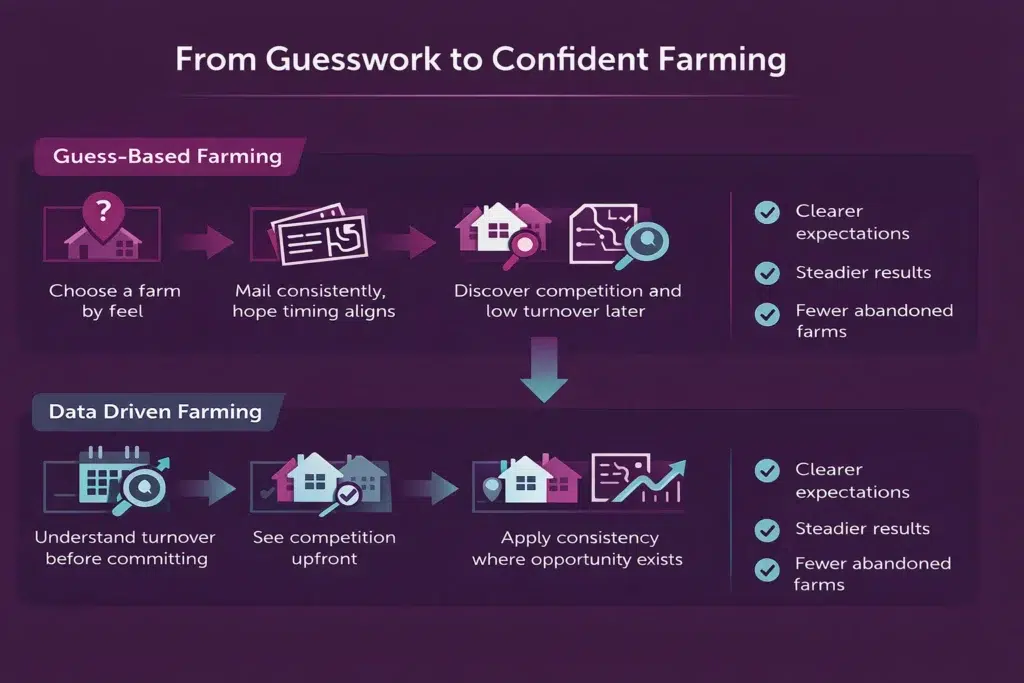
- Farms are chosen before turnover is understood: Many agents select farms based on size, price point, or familiarity, without knowing how often homes actually sell. When turnover is low, even consistent mailing can feel slow and unproductive.
- Competition inside the farm is underestimated: Agents often commit to a neighborhood without realizing how many others are mailing the same homes. Heavy agent saturation can dilute impact and extend the time it takes for consistency to pay off.
- Campaigns measure responses instead of opportunity: Calls, scans, and leads are tracked after money is spent, but the real question is whether the farm had enough opportunity to begin with. Without that context, results can feel misleading.
- Adjustments happen too late — or not at all: Lacking clear insight, agents either stick with underperforming farms out of habit or abandon good ones too early. Both decisions are usually made without enough information.
The result?
A campaign that’s consistent, well-designed, and thoughtfully executed — but still feels unpredictable.
This is where direct mail has quietly evolved. Not by replacing the fundamentals, but by giving agents better clarity around where their consistent efforts will matter most.
What Is a Smart Direct Mail Marketing Strategy in Today’s Market?
A smart direct mail marketing strategy doesn’t replace the fundamentals — it sharpens them.
Consistency remains at the core. Branding still matters. Messaging still matters. But what agents are doing differently today is being far more intentional about where that consistent effort is focused and why.
Instead of asking, “How do I mail better?”
The better question has become, “Where will my mail have the highest chance of paying off?”
That shift changes everything.
A modern direct mail strategy is based on clarity before execution. In practice, that usually means concentrating on a few key principles.
1. Start with opportunity, not geography
Rather than choosing a farm simply because it fits a size or price range, smart strategies begin by understanding how active the area actually is. Higher turnover doesn’t guarantee listings — but it does mean your consistent presence has a better chance to be seen at the right moment.
2. Apply consistency where it has the most impact
Consistency works best when it’s applied in areas that can support it long-term. When turnover is too low or competition too high, even great campaigns can feel slow. When opportunity and consistency align, results tend to grow more naturally over time.
3. Include competition in your planning from the start
Competition isn’t something to respond to later — it’s something to plan for. Knowing whether you’re entering a lightly farmed area or a highly saturated one helps to set realistic expectations for timing, frequency, and messaging.
4. View direct mail as part of a broader marketing system
The most effective direct mail campaigns don’t operate in isolation. They support listing activity, reinforce market authority, and work alongside digital channels — all while focusing on a clearly defined audience.
At this level, direct mail is less about sending postcards and more about making informed choices repeatedly. The mailing itself remains simple. The strategy behind it becomes sharper.
That naturally leads to the next question agents tend to ask once they’ve refined their approach:
How Should a Real Estate Marketing Plan Support Direct Mail?
A direct mail campaign works best when it’s not treated as a standalone tactic, but as a core pillar inside a larger real estate marketing plan.
For agents, direct mail isn’t about chasing quick responses. It’s about staying visible, credible, and familiar in the moments that matter — before someone decides to move, not after.
That’s why the strongest marketing plans don’t ask, “What should this postcard say?”
They ask, “What role is direct mail playing in my overall strategy?”
Here’s what that support typically looks like in practice.
- Direct mail anchors long-term visibility: While digital channels fluctuate, direct mail provides steady, tangible exposure in the same households over time, helping your brand stay familiar.
- It reinforces authority created elsewhere: Listings, sold homes, and market insights don’t live only online. Mail extends that authority into the neighborhood, strengthening recognition.
- It supports timing, not just messaging: Homeowners don’t move all at once. Direct mail works quietly in the background so your name feels familiar when timing aligns.
- It creates consistency across channels: When branding, positioning, and geography align across mail and digital touchpoints, recognition builds faster and feels more cohesive.
When direct mail is supported this way, it stops feeling like a cost that needs constant justification. It becomes an asset that compounds over time.
Traditional Direct Mail Campaigns vs. Data-Driven Campaigns
Most agents don’t intentionally run inefficient direct mail campaigns. They run what’s familiar — what’s always worked — and rely on consistency to carry the results.
And to be clear, traditional direct mail still works. But as markets become more competitive and costs rise, real estate agents are starting to look for ways to make those consistent efforts more precise.
That’s where the difference between a traditional and a data-driven direct mail campaign becomes clear.
The key difference isn’t effort — it’s visibility.
Here’s how the two approaches typically compare:

Natali Amato
Lorem ipsum dolor
In a traditional setup, agents often commit first and learn later. Results eventually come — but usually slower, and with more uncertainty along the way.
A data-driven approach doesn’t remove consistency or patience. It simply reduces blind spots. Agents still mail regularly, still build recognition, and still play the long game — but with a clearer understanding of whether the farm can realistically support those efforts.
For many REALTOR’s, this comparison sparks an important realization:
It’s not about mailing more.
It’s about mailing smarter — in places where consistency has room to work.
That naturally leads to the next step in the conversation: understanding what actually goes into a high-performing campaign.
The Anatomy of a High-Performing Real Estate Direct Mail Campaign
When a direct mail campaign works, it’s rarely because of one single element. It’s usually the result of a few core components working together — consistently — over time.
High-performing agents don’t treat these pieces as separate decisions. They treat them as a system.
Here’s what that system typically includes.
- Farm selection based on real turnover: High-performing campaigns start in areas where homes are actually moving. Turnover creates opportunity, and without it, even the most consistent campaigns take much longer to gain traction.
- Clear visibility into agent competition: Knowing how many agents are actively marketing in a farm helps set realistic expectations. Less competition allows consistency to compound faster, while heavier saturation requires longer commitment and sharper positioning.
- Consistent mailing cadence over time: Recognition is built through repetition. Successful campaigns commit to a steady cadence that homeowners come to expect, rather than relying on short bursts or irregular mailings.
- Simple, repeatable messaging: High-performing campaigns don’t chase novelty. They reinforce the same core message repeatedly, focusing on familiarity and trust rather than trying to impress with constant changes.
- Thoughtful evaluation instead of constant reinvention: Rather than restarting campaigns frequently, strong performers observe patterns, make informed adjustments, and allow time for results to develop without overreacting to short-term fluctuations.
This keeps the section:
When these elements are aligned, direct mail stops feeling unpredictable. It becomes steady, measurable, and far easier to justify as part of a long-term marketing plan.
At this point, many agents ask a practical question:
If this is what a strong campaign looks like, what actually helps agents execute it more effectively?
How PowerFarm Helps Agents Build Smarter Direct Mail Campaigns
For agents who already believe in direct mail, the challenge usually isn’t whether to stay consistent — it’s where that consistency will actually pay off.
That’s the gap PowerFarm was built to address.
Instead of asking agents to mail more, redesign more, or experiment endlessly, PowerFarm focuses on improving the decisions that happen before a postcard is ever sent.
Here’s how that plays out in practice.
Clear visibility into turnover
PowerFarm helps agents understand how frequently homes are selling in a specific area. That clarity makes it easier to judge whether a neighborhood can realistically support a long-term direct mail campaign — before committing months of spend.
This doesn’t guarantee listings. It simply removes one of the biggest unknowns.
Real insight into agent competition
Rather than discovering saturation over time, agents can see how competitive a farm already is. That helps set expectations early — whether the goal is entering a quieter area where consistency compounds faster, or committing strategically to a more competitive farm with a longer runway.
Confidence in sticking with the right farms
One of the hardest parts of direct mail is knowing when to stay the course and when to change direction. PowerFarm gives agents more context around those decisions, reducing the temptation to abandon farms prematurely or double down blindly.
Consistency, supported by clarity
Importantly, PowerFarm doesn’t change the fundamentals. Agents still mail consistently. They still build recognition over time. The difference is that consistency is applied with more confidence, better expectation-setting, and less second-guessing.
For many agents, that shift alone makes direct mail feel far more manageable — and far easier to justify as a long-term strategy.
At this point, a fair question usually comes up:
Is this kind of data-driven approach actually worth it if you’re already mailing consistently?
What Results Can You Expect From a Real Estate Direct Mail Campaign?
For agents, results aren’t about whether direct mail “works.”
They’re about how long it takes, what it costs, and what a reasonable return looks like when a campaign is run consistently.
When direct mail is treated as a long-term strategy, results tend to follow a predictable pattern.
What results usually look like over time
Most successful real estate direct mail campaigns don’t break even in the first few mailings. Instead, performance builds as recognition compounds.
A common timeline looks like this:
- Months 1–3:
Brand recognition begins, but measurable results are limited. This is the awareness phase. - Months 4–6:
Familiarity increases. Homeowners start recognizing the agent’s name when selling conversations begin. - Months 6–12:
Listings and referrals start appearing from the farm, often from homeowners who have seen multiple mailings.
*This doesn’t guarantee listings — but it reflects how consistent exposure typically translates into opportunity.
Typical cost and return considerations
Rather than focusing only on response rates, agents often evaluate results using broader metrics:
- Monthly mailing cost (printing + postage)
- Total annual campaign spend
- Listings generated from the farm over time
- Average commission per listing
For example:
- Mailing 1,000 homes monthly
- At an average cost of $1.04 per piece
- Results in an annual spend of approximately $12,480
In most markets, a single closed listing can cover your entire year’s mailing cost.
This is why direct mail results are usually evaluated over a year, not a month.
Why farm selection impacts results so heavily
Two agents can mail the same number of homes, with the same consistency, and see very different outcomes.
The difference often comes down to:
- turnover rate in the farm
- number of competing agents
- how long the agent stays consistent
Higher turnover and lower competition don’t guarantee results — but they shorten the runway needed for recognition to turn into listings.
How agents estimate ROI before committing
Instead of guessing, many agents model expected outcomes before launching or expanding a campaign by estimating:
- annual mailing cost
- realistic number of listings over 12 months
- average commission per transaction
This approach doesn’t promise results — it provides clarity.
What strong results usually have in common
Across markets and farm sizes, high-performing direct mail campaigns tend to share a few traits:
- consistent monthly presence
- clearly defined farm boundaries
- realistic expectations around timing
- patience supported by insight, not guesswork
When those elements are aligned, results become measurable, repeatable, and easier to justify as part of a long-term marketing plan.
Common Direct Mail Campaign Questions
Most agents see the best results by mailing consistently over time, not sporadically. Monthly or bi-monthly campaigns allow recognition to build naturally and keep your name familiar when homeowners are ready to act.
How often should you run a real estate direct mail campaign?
Most REALTORS see the best results by mailing consistently over time, not sporadically. Monthly or bi-monthly campaigns allow recognition to build naturally and keep your name familiar when homeowners are ready to act.
What matters more in a direct mail campaign: design or farm selection?
Both matter, but farm selection comes first. A strong design can’t overcome low turnover or heavy saturation. When the right audience is chosen, even simple, repeatable designs can perform well over time.
Can direct mail still work in competitive real estate markets?
Yes — but expectations need to be realistic. In competitive markets, direct mail often requires longer consistency and clearer positioning. Understanding competition upfront helps agents commit strategically instead of getting discouraged early.
Is direct mail better as a short-term or long-term marketing strategy?
Direct mail works best as a long-term strategy. It builds familiarity and trust gradually, supporting listing opportunities over time rather than generating immediate spikes in responses.
Key Takeaways for Building a Strong Direct Mail Campaign
Direct mail hasn’t lost its place in real estate marketing — it’s simply become more intentional.
For real estate agents, the shift isn’t about doing more. It’s about applying the same consistency in places where it actually has room to work.
Direct mail succeeds when homeowners see your name often enough to remember it — but that only happens when the farm itself makes sense. Areas with real turnover and manageable competition give consistency something to build on, instead of forcing you to guess.
That’s why understanding opportunity before you mail matters just as much as tracking results afterward. When expectations are clear from the start, decisions feel steadier and fewer efforts get wasted.
Smarter insight doesn’t replace the fundamentals that make direct mail effective. It simply helps you apply them with more confidence and patience.
At the end of the day, the strongest direct mail campaigns aren’t louder or more complicated. They’re consistent, well-placed, and built to last.
Become the REALTOR Everyone Knows and Trusts
Create and ship professional real estate marketing materials within minutes.

Kirk Weingartens
ROVI Homes
“It's absolutely something you're gonna want to do if your in the real estate business.”
| 10x ROI | 6 Listings | $100k GCI |


Ledeen Hangen
Realty One Group, Lowcountry
“I would not be where I am today had it not been for Wise Pelican and their guidance.”
| 6.6x ROI | 14 Listings | $150k GCI |


Eric Kirkwell
Heart and Home Orlando
“It's very easy for us on our marketing budget to say this how much we're spending and this is the return we're getting, and the ROI has been 10-to-1.”
| 10x ROI | 12 Listings |
Our Latest Blogs
Data-Driven Direct Mail for Real Estate: Farm Smarter With Data

Seasonal Real Estate Postcards To Use In 2026