Data-Driven Direct Mail for Real Estate: Using Agent Saturation and Turnover to Farm Smarter
Most agents start real estate farming by guessing and hoping for results.
They pick an area that feels promising, without looking at the data behind it. Over time, the results feel inconsistent. Some months look promising. Others go quiet. And it’s hard to tell whether the problem is the message, the timing, or the area itself.
What’s usually missing isn’t effort — it’s direct mail data. Without understanding agent saturation and turnover, agents end up farming on instinct instead of strategy. That’s exactly why data-driven direct mail matters: it replaces guessing with measurable opportunity.
This article explores:
- What is Agent Saturation In Real Estate
- What is Turnover Data In Real Estate Farming?
- How to Build A Data Driven Farming Strategy


What Is Agent Saturation in Real Estate?
Agent saturation measures how competitive a farming area is. In simple terms, it answers:
How many agents are actively marketing to the same homeowners?
If saturation is high, you’re entering a crowded battlefield. If it’s low, you may have an opportunity to establish dominance faster.
But here’s the nuance most people miss:
High saturation isn’t always bad. Low saturation isn’t always good.
What matters is how saturation interacts with turnover.
What Is Turnover Data in Real Estate Farming?
Turnover data tells you how often homes in an area are selling.
It answers questions like:
- How frequently do listings come up?
- Are homeowners moving every few years or staying long-term?
- Is there enough activity to justify consistent marketing?
Turnover is what determines whether an area can realistically support your goals.
An area with low turnover might look peaceful — but if homes rarely sell, your pipeline dries up.
How Agent Saturation and Turnover Work Together
This is where data-driven direct mail campaigns get interesting.
Saturation alone doesn’t tell the full story. Turnover alone doesn’t either.
You need to look at both.
Here’s a simplified framework:
| Area Type | Agent Saturation | Turnover Rate | What It Means for Direct Mail |
|---|---|---|---|
| Competitive Hotspot | High | High | Strong opportunity, but requires consistent branding and frequency |
| Hidden Opportunity | Low | High | Ideal farming zone with strong listing potential |
| Quiet Zone | Low | Low | Easier entry but limited listing volume |
| Crowded Desert | High | Low | High effort with minimal payoff |
The sweet spot most agents look for is low-to-moderate saturation with healthy turnover.
That’s where digital direct mail marketing data becomes a real advantage. Instead of guessing, you’re choosing areas based on measurable opportunity.
Why Most Direct Mail Campaigns Underperform
When campaigns fail, it’s rarely because direct mail “doesn’t work.”
It’s usually because the strategy is incomplete.
Common mistakes include:
- Mailing areas with low turnover and expecting fast results
- Entering oversaturated markets without a differentiation plan
- Sending inconsistent mailers with no long-term presence
- Ignoring performance data and relying on guesswork
Data-driven direct mail fixes this by replacing assumptions with measurable signals.
How to Build a Data-Driven Direct Mail Strategy
Most agents know they should use data, but few actually build their real estate farm using data. A true data-driven direct mail strategy uses agent saturation and turnover insights to decide where effort creates the highest return — not just where it feels convenient to mail.
When you structure data-driven direct mail campaigns around real market signals and digital direct mail marketing data, your decisions become intentional. The process is simple, but each step builds on the last.
Step 1: Analyze Turnover First
Turnover determines opportunity volume. Look for areas where listings happen consistently enough to support your goals.
Step 2: Evaluate Agent Saturation
Understand how competitive the landscape is. Ask:
- Are a few agents dominating?
- Is the market fragmented?
- Is there room for a new consistent presence?
Step 3: Match Effort to Opportunity
Higher competition requires:
- Stronger branding
- More frequent mailings
- Longer commitment
Lower competition allows faster positioning.
Step 4: Track Engagement Signals
Modern direct mail isn’t disconnected from digital.
QR codes, landing pages, and automated follow-ups help you connect digital direct mail marketing data with real-world behavior.
This closes the feedback loop.
The Role of Digital Direct Mail Marketing Data
Today’s campaigns aren’t purely print. They’re hybrid systems. Digital signals help you:- Measure engagement trends
- Identify homeowner interest patterns
- Optimize messaging over time
- Refine geographic targeting
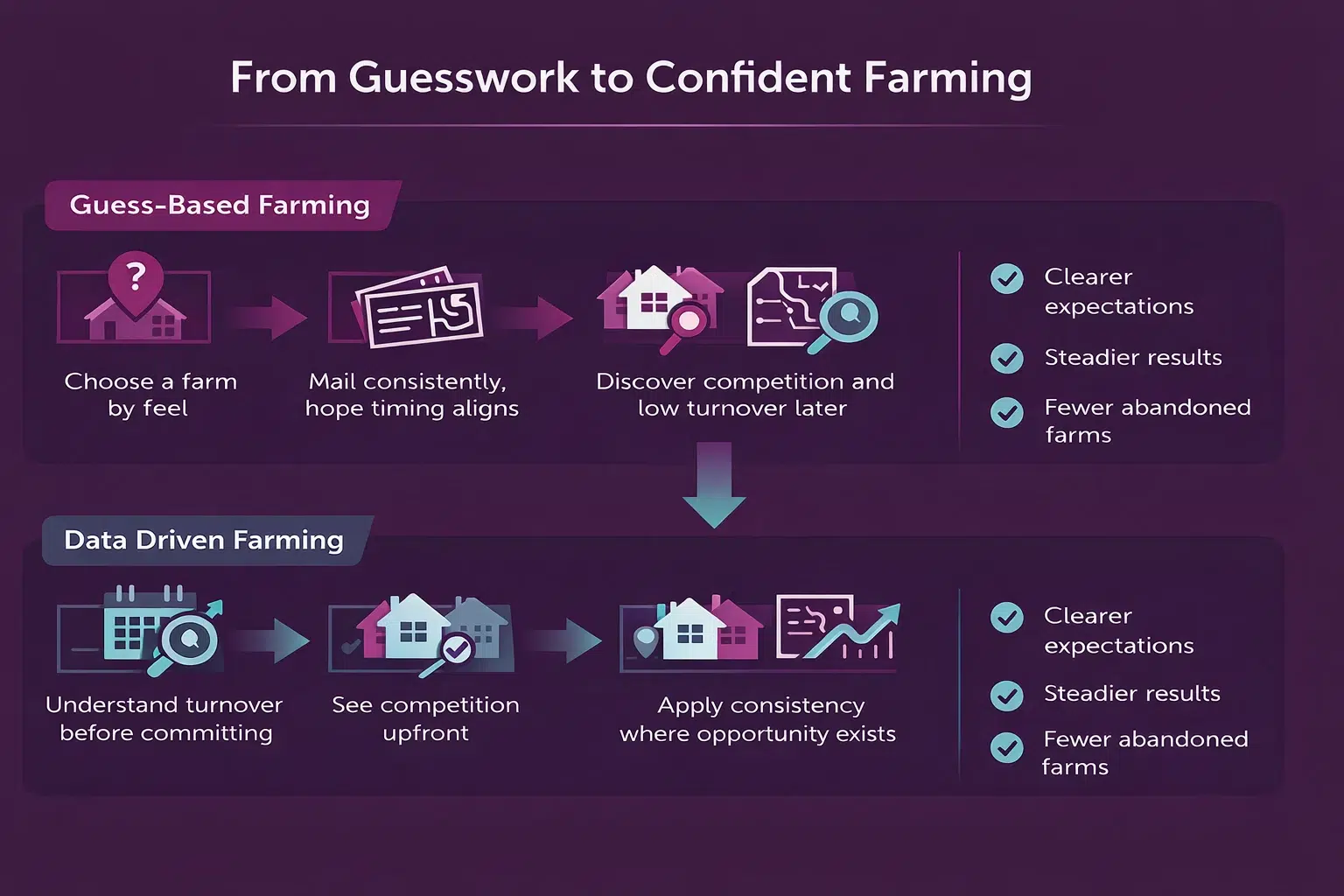
What Happens When You Farm With Data Instead of Guesswork?
When your strategy is built on direct mail data, your farming stops feeling random and starts becoming predictable. You’re no longer choosing areas based on proximity or past assumptions — you’re building data-driven direct mail campaigns around turnover, agent saturation, and real engagement signals. That shift doesn’t just improve performance; it changes how confidently you invest your time and budget.Farming With Data
With a data-driven direct mail approach, every decision has a reason behind it. You know why you’re mailing a specific neighborhood, how competitive it is, and what level of opportunity exists — before the first postcard goes out.- You choose farm areas based on turnover, not convenience
- You understand agent saturation before committing your marketing spend
- You stay consistent because the numbers justify the long-term play
- You track performance using digital direct mail marketing data like QR scans and page visits
- You refine your campaign instead of constantly restarting it
- You build recognition in areas where listings are statistically more likely
Farming With Guesswork
When there’s no reliable direct mail data, even consistent effort can feel uncertain. You’re making decisions based on surface-level signals, and when results are slow, it’s hard to know what to fix — or whether to start over somewhere new.- You pick areas because they “seem” active
- You enter highly saturated markets without realizing it
- You switch farms too early and lose momentum
- You invest in neighborhoods with low turnover
- You can’t tell whether the issue is the list, the design, or the location
- You spread your budget across multiple areas instead of dominating one
The Long-Term Advantage of Data-Driven Farming
Direct mail is not the quick and easy approach. It is about positioning yourself in the right neighborhood. Then, staying consistent in front of your farm long enough to get the results you want. By utilizing agent saturation rates and turnover data, you majorly improve your chances of getting leads, getting listings. Whilst nothing can guarantee results. You do position yourself with the highest possibility of success. And for agents who take farming seriously, that edge compounds over time.FAQ: Agent Saturation and Direct Mail Data
How does agent saturation affect direct mail performance?
Higher saturation increases competition but can still be profitable if turnover is strong and branding is consistent.Why is turnover more important than mailing volume?
Turnover determines how many listing opportunities actually exist in a farming area.Can digital data improve print direct mail campaigns?
Yes. Digital tracking bridges offline mail with measurable engagement signals.Become the REALTOR Everyone Knows and Trusts
Create and ship professional real estate marketing materials within minutes.

Kirk Weingartens
ROVI Homes
“It's absolutely something you're gonna want to do if your in the real estate business.”
| 10x ROI | 6 Listings | $100k GCI |


Ledeen Hangen
Realty One Group, Lowcountry
“I would not be where I am today had it not been for Wise Pelican and their guidance.”
| 6.6x ROI | 14 Listings | $150k GCI |


Eric Kirkwell
Heart and Home Orlando
“It's very easy for us on our marketing budget to say this how much we're spending and this is the return we're getting, and the ROI has been 10-to-1.”
| 10x ROI | 12 Listings |
Our Latest Blogs

Real Estate Direct Mail Campaigns: Insights, Strategy, and Results

Seasonal Real Estate Postcards To Use In 2026